Monday, February 28, 2011

Wednesday, January 19, 2011
The world's most famous unknown artist:
YOKO ONO
"Painting to Hammer a Nail"


"Painting to Hammer a Nail"

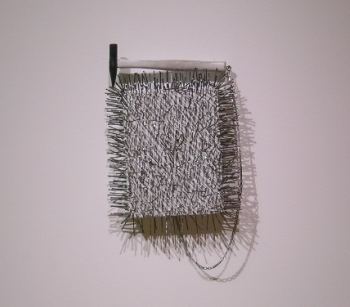
The label on the piece:
Painting to Hammer a Nail, 1961/2009
Painted wood panel with 42 -inch chain and container
with 1½- to 2-inch finishing nails
Yoko Ono
American (born in Japan), 1933
Collection of the artist
Museum visitors are invited to pound a nail into this painting.
While the idea might at first seem a destructive, physically aggressive act against the accepted traditions of painting and museums in general, in the end the concept opens up new potentials for painting, and for bringing others besides the artist into the creative act.
This piece by Yoko Ono is the perfect example of the historical survey of the attacks that painting endured in the years following World War II.
For artists like Ono, painting had become a trap, and they devised numerous ways to escape the conventions and break the traditions that had been passed down to them over hundreds of years. This phenomenon occurred in all parts of the world, lead by artists that shoot, rip, tear, burn, erase, nail, unzip and deconstruct painting in order to usher in a new way of thinking.
In 1998 Yoko Ono’s “Painting to Hammer a Nail” was on displayed at LA MoCA – with one key difference. There was a small sign next to the piece saying “Please Don’t Touch.”
Recently Ono's "painting to hammer a nail" was part of the Seattle exhibit Target Practice: Painting Under Attack 1949-78, but now something different happened:
(someone says because people from Seattle didn't follow her instructions)
They started to hammering nails, but then they gave up,
Here's the piece on Friday:
Here it is Tuesday:
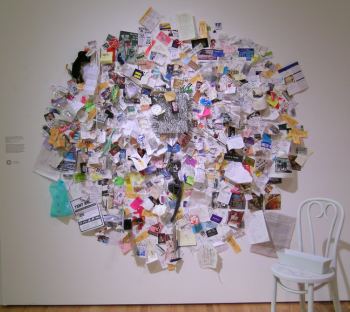
Instead of a place for pounding out the artist's message,
it became a community bulletin board.
Individuals nailed business cards, ticket stubs,
and other paper items to the wall of the museum.
But that's not the weirdest thing about the new evolution
of Ono's piece:
Feeling compelled by the artwork, Amanda Mae
interacted with Ono (and the community’s) creation
in her own way: by taking down some of the papers.
This article summarizes Mae’s actions:
“She worked at the museum, so she knew that the protocol was to pick up and save any papers that fell off in the course of new ones being hammered on, so as she removed papers she set them in piles (ticket stubs here, business cards there), intending to leave each pile like a gift at the base of the piece for the guards to carry off and put in the utility closet with all the others. She left the nails in their places. She called her installation Yoko Ono Excavation Survey, or Y.E.S.”
Amanda Mae’s actions were called vandalism and, according to The Stranger’s Online Blog (SLOG), the museum’s spokeswoman, Nicole Griffin, responded, “I can say that this is a work of art that’s hanging on the wall in our museum, and altering a work of art hanging on the wall of a museum is never really an okay thing to do.”
But wait. Wasn’t that the point of the piece: to alter the work of art hanging on the wall?
Monday, January 17, 2011


a Scene from Apocalypse Now, F.F. Coppola - 1979:
http://www.youtube.com/watch?v=h5JXrP8yv8o
The Hollow Men, T.S. Elliot - (1925)
Mistah Kurtz—he dead.A penny for the Old Guy
I We are the hollow men
We are the stuffed menLeaning together Headpiece filled with straw. Alas! Our dried voices, when We whisper together Are quiet and meaningless As wind in dry grass Or rats’ feet over broken glass In our dry cellar Shape without form, shade without colour, Paralysed force, gesture without motion; Those who have crossed With direct eyes, to death’s other Kingdom Remember us—if at all—not as lost Violent souls, but only As the hollow men The stuffed men.
II
Eyes I dare not meet in dreams In death’s dream kingdom These do not appear: There, the eyes are Sunlight on a broken column There, is a tree swinging And voices are In the wind’s singing More distant and more solemn Than a fading star. Let me be no nearer In death’s dream kingdom Let me also wear Such deliberate disguises Rat’s coat, crowskin, crossed staves In a field Behaving as the wind behaves No nearer—
Not that final meeting In the twilight kingdom
III
This is the dead land This is cactus land Here the stone images Are raised, here they receive The supplication of a dead man’s hand Under the twinkle of a fading star. Is it like this In death’s other kingdom Waking alone At the hour when we are Trembling with tenderness Lips that would kiss Form prayers to broken stone. IV
The eyes are not here There are no eyes here In this valley of dying stars In this hollow valley This broken jaw of our lost kingdoms In this last of meeting places We grope together And avoid speech Gathered on this beach of the tumid river Sightless, unless The eyes reappear As the perpetual star Multifoliate rose Of death’s twilight kingdom The hope only Of empty men.
VHere we go round the prickly pear
Prickly pear prickly pear Here we go round the prickly pear At five o’clock in the morning.
Between the idea And the reality Between the motion And the act Falls the Shadow For Thine is the Kingdom
Between the conception And the creation Between the emotion And the response Falls the Shadow Life is very long
Between the desire And the spasm Between the potency And the existence Between the essence And the descent Falls the Shadow For Thine is the Kingdom
For Thine is Life is For Thine is the
This is the way the world ends This is the way the world ends This is the way the world ends Not with a bang but a whimper.
Sunday, January 16, 2011

I would like to share with you this essay I'm reading:
http://barneygrant.tripod.com/cultureindustry.htm
expecially the part "Television as part of culture industries":
"It seems unreasonable then, at least in hindsight, to expect any type of television to perform a role exterior to the social conditions of the time. Rather, television is a form of social, commercial and political manipulation, a form which aims at integrating its audience. The semiotics of “mass communication” are rarely examined: such a description of TV's role and actions is one successfully kept from its consumers, who are encouraged to believe that all they see and hear is normal, and when change occurs, progressive. Cultural expectations are thus aligned with the expectations of investors, the goals of entrepreneurism and the purposes of technological innovators."
Saturday, January 15, 2011
Subscribe to:
Comments (Atom)