"Painting to Hammer a Nail"

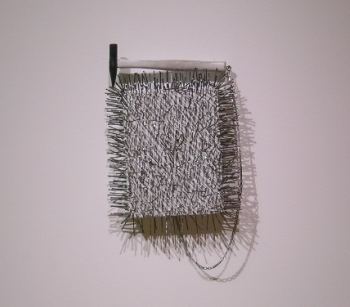
The label on the piece:
Painting to Hammer a Nail, 1961/2009
Painted wood panel with 42 -inch chain and container
with 1½- to 2-inch finishing nails
Yoko Ono
American (born in Japan), 1933
Collection of the artist
Museum visitors are invited to pound a nail into this painting.
While the idea might at first seem a destructive, physically aggressive act against the accepted traditions of painting and museums in general, in the end the concept opens up new potentials for painting, and for bringing others besides the artist into the creative act.
This piece by Yoko Ono is the perfect example of the historical survey of the attacks that painting endured in the years following World War II.
For artists like Ono, painting had become a trap, and they devised numerous ways to escape the conventions and break the traditions that had been passed down to them over hundreds of years. This phenomenon occurred in all parts of the world, lead by artists that shoot, rip, tear, burn, erase, nail, unzip and deconstruct painting in order to usher in a new way of thinking.
In 1998 Yoko Ono’s “Painting to Hammer a Nail” was on displayed at LA MoCA – with one key difference. There was a small sign next to the piece saying “Please Don’t Touch.”
Recently Ono's "painting to hammer a nail" was part of the Seattle exhibit Target Practice: Painting Under Attack 1949-78, but now something different happened:
(someone says because people from Seattle didn't follow her instructions)
They started to hammering nails, but then they gave up,
Here's the piece on Friday:
Here it is Tuesday:
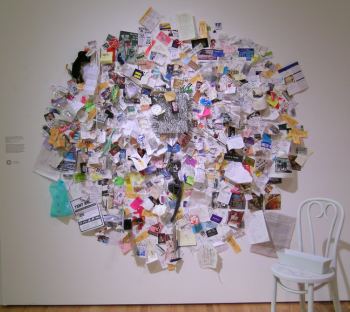
Instead of a place for pounding out the artist's message,
it became a community bulletin board.
Individuals nailed business cards, ticket stubs,
and other paper items to the wall of the museum.
But that's not the weirdest thing about the new evolution
of Ono's piece:
Feeling compelled by the artwork, Amanda Mae
interacted with Ono (and the community’s) creation
in her own way: by taking down some of the papers.
This article summarizes Mae’s actions:
“She worked at the museum, so she knew that the protocol was to pick up and save any papers that fell off in the course of new ones being hammered on, so as she removed papers she set them in piles (ticket stubs here, business cards there), intending to leave each pile like a gift at the base of the piece for the guards to carry off and put in the utility closet with all the others. She left the nails in their places. She called her installation Yoko Ono Excavation Survey, or Y.E.S.”
Amanda Mae’s actions were called vandalism and, according to The Stranger’s Online Blog (SLOG), the museum’s spokeswoman, Nicole Griffin, responded, “I can say that this is a work of art that’s hanging on the wall in our museum, and altering a work of art hanging on the wall of a museum is never really an okay thing to do.”
But wait. Wasn’t that the point of the piece: to alter the work of art hanging on the wall?


